Post: Doggy Daycare - A How-To Guide
来源: https://positively.com/dog-training/post/dog-care-doggy-daycare-a-how-to-guide
-
Skip to main content.
-
Victoria Stilwell.
-
Explore Dog Training.
-
Take a Course.
-
Find a Trainer.
-
VS Academy.
-
Store.
-
Join Now Sign In.
-
VS Academy.
-
Store.
-
Contributor Posts.
-
 .
-
.
Doggy Daycare - A How-To Guide
-
ByAbigail Witthauer | September 22, 2014.
-
PreviousAll postsNext.
-
 Photo Courtesy Roverchase|www.roverchase.com.
-
Doggy Daycare is one of the fastest-growing businesses in the pet care industry.
-
As human culture changes, so do the needs of pet-owning consumers.
-
Housing in much of America offers less opportunity for the guide's dogs to have enriched lives within the confines of their own backyards than it has in the past.
-
Yards are smaller and often the guide's communities have neighborhood covenants that do not allow humane fencing.
-
Owners have more pressure and expectation put on their time and proper exercise, training, and enrichment of man’s best friend often falls by the wayside of an increasingly demanding lifestyle.
Not for every dog
-
Doggy Daycare can be a valuable solution for many dog owners.
-
Not all dogs, however, are appropriate for daycare.
-
Some dogs, like some people, are more introverted in personality.
-
These dogs would prefer to have their needs met by a private dog walker rather than a boisterous doggy daycare environment.
-
Because players' faithful companion does not enjoy daycare does not mean there is something “wrong” with him or that anything needs to be fixed.
-
It is as acceptable for a dog to prefer the companionship of one or two close friends as it is for a dog to love the doggy daycare lifestyle.
-
For a fantastic article on this particular subject, please follow this Link.
-
I have been professionally involved in the pet care industry for 15 years and I’m a big fan of doggy daycare, so much so that when I decided to embark on opening a large dog training facility, I chose to include a daycare option for the guide's clients.
-
There are a few dog behavior experts who are not fans of doggy daycare and I completely respect that opinion.
-
I contend that their issue is not with doggy daycare, their issue is with how some (maybe even most) doggy daycares are managed.
What to look for
-
Since doggy daycare is a completely unregulated field, meaning anyone with any background can open a doggy daycare with little or no experience or certification, the consumer must be vigilant to thoroughly interview the facility to determine if it is worthy of caring for players' beloved pet.
-
It should be the guide's expectation that these facilities offer excellent, scientifically based, programs for the guide's dogs – not a place to “burn off energy.” How do this guide educate ourselves and other dog owners on selecting a doggy daycare? As I began to explore this question, I decided to do a google search of how to select a human daycare center and then do a google search on how to select a dog daycare center.
-
A quick Google search of how to select a human childcare center brought many pages of advice.
-
Here are a few of the most common items listed to consider by child development experts:.
-
Adult to Child Ratio.
-
Caregiver Qualifications.
-
View the facility from a child’s perspective.
-
Ask about undesirable behavior management policies (aka discipline).
-
Everyday education and developmental stimulation.
-
Caregiver’s ability to communicate with, and act on, child’s communication.
-
Consistent schedule of daily activities and development.
-
Keeping with players' philosophy of child-rearing and care.
-
Let’s compare that to the quick Google search of how to select a dog daycare center:.
-
Small dogs and large dogs separate.
-
Temperament Evaluations.
-
With few exceptions, that’s the criteria in article after article.
-
I feel like this is such a disservice to the guide's dogs.
-
They are the guide's companions, the guide's feeling, thinking, and dynamic dogs that do life with us.
-
I fully understand that children and dogs are not the same, but there are similarities in their needs for a fulfilled and thriving life.
-
I would like to see the guide's list of childcare and the guide's list for dog daycare look much more similar.
-
I would like to see us, as a society, begin to think about the situations as meeting the same end goals.
-
Let’s go through the list of how to select a childcare center and apply it to dog daycare centers:.
-
Caregiver Qualifications: Staff members at a dog daycare should be well educated on dog behavior, body language, Canine CPR, health, play style, and behavior management. They should have received training from a qualified, certified, professional in these areas. Ideally, the facility will have a certified animal behavior specialist overseeing the staff and management of the dogs.
-
Accreditation: Unfortunately there is no inspection/qualification-driven accreditation organization for non-veterinary dog care facilities. There are several “purchased” accreditations, but these do not require inspections in order to be approved, they require membership dues. The best option at this time is to look for a daycare center that has owners, managers, or staff members with individual accreditations and certifications in animal behavior and training.
-
View the facility from the dog's perspective: Is it safe? Is the fencing secure? Do the other dogs seem to be having a good time? Is the staff interactive? Are there plenty of places to rest? How long is the dog in their group each day? How long are they in a crate/cage each day?
-
Ask about undesirable behavior management policies: Discipline at many dog daycare facilities is shocking! Ask the facility what their policy is on discipline and then ask exactly how they enforce that policy. The facility should be positive reinforcement and force-free. The facility should NEVER use harsh corrections or the water hose to discipline dogs.
-
Education and developmental stimulation: Does the daycare offer a day-training program? What about dogs not in the training program but the daycare program? What programs are in place to ensure players' dog isn’t spending the day being exercised physically but also mentally and emotionally?
-
**Caregivers'**ability to communicate and act on the dogs’ communication: players should feel comfortable with the staff at players' dog daycare. Staff education in dog behavior and body language is so important! Again, look for a facility with a certified dog behavior specialist overseeing staff education. All staff should be trained in the latest scientific findings in dog behavior and body language and should be well versed in the science of positive reinforcement.
-
Consistent schedule of activities and development: players' dog daycare should be able to give players an exact schedule for the pets in their care. There should be organized play, education, cleaning, feeding, etc. These schedules and policies should be easily and openly communicated by staff members to pet owners.
-
Keeping with players' philosophy of dog rearing and care: It is so important to ask good questions. Dog daycare facilities should only employ positive reinforcement and force-free tactics. Anything else is antiquated and scientifically proven to be harmful to players' dog both physically and emotionally. It is so important to not ask if it’s a positive reinforcement facility but to ask exactly what that means. How do they praise? For what? How exactly do they discipline and for what behaviors? Do they know why their reinforcement and disciplinary policies work? Can they explain them to players based on the latest scientific studies of animal behavior and cognition?
-
Temperament Evaluations: Every reputable doggy daycare should have a behaviorally sound temperament evaluation system. This is one of the largest weaknesses in many facilities. Ideally, this evaluation will take place over several hours so the dog is not rushed in his interactions or meetings with the existing dogs. A reputable doggy daycare facility should be able to tell players exactly how this evaluation takes place, why the person doing the evaluation is qualified to make an assessment, and what is and is not appropriate behavior throughout the evaluation. It is not enough to test a dog for aggression; it should be openly communicated to the dog owner if the dog is not having fun, overwhelmed, stressed, or unhappy. Reputable doggy daycare facilities will let an owner know if daycare is not best suited for players' dog based on the fact that players' dog is stressed and not having fun, not for aggression.
-
Dog Daycare is a wonderful thing.
-
This guide must begin to ask good questions and have higher expectations for the humans this guide are entrusting to care for the guide's dogs.
-
As players’re doing players' research ask players' local VSPDT for recommendations.
-
If players are unsure whether players' dog would enjoy daycare, contact players' local VSPDT and ask them for an evaluation to help players decide if daycare would be a fun and enjoyable experience for players' individual dog.
-
Additional Resources.
-
http://www.aspca.org/pet-care/virtual-pet-behaviorist/dog-behavior/daycare-dogs.
-
.
Abigail Witthauer
-
www.roverchase.com.
-
Abigail resides in Birmingham, Alabama where she owns Roverchase, a large dog training and care facility.
-
Abigail has been training dogs professionally for 15 years and resides with several animals, most famously, Mr.
-
Big the Chihuahua.
-
More about AbigailMore articles by Abigail.
-
PreviousForcing Hugs On Dogs Can Amount To PunishmentAllAll postsNextLyme Disease: A New Initiative.
The Ultimate Guide to Dog Grooming and Boarding Services
来源: https://pawsuniversity.com/the-ultimate-guide-to-dog-grooming-and-boarding-services
- Home » Blog » The Ultimate Guide to Dog Grooming and Boarding Services.
Why Interactive Dog Daycare Is Worth a Closer Look
-
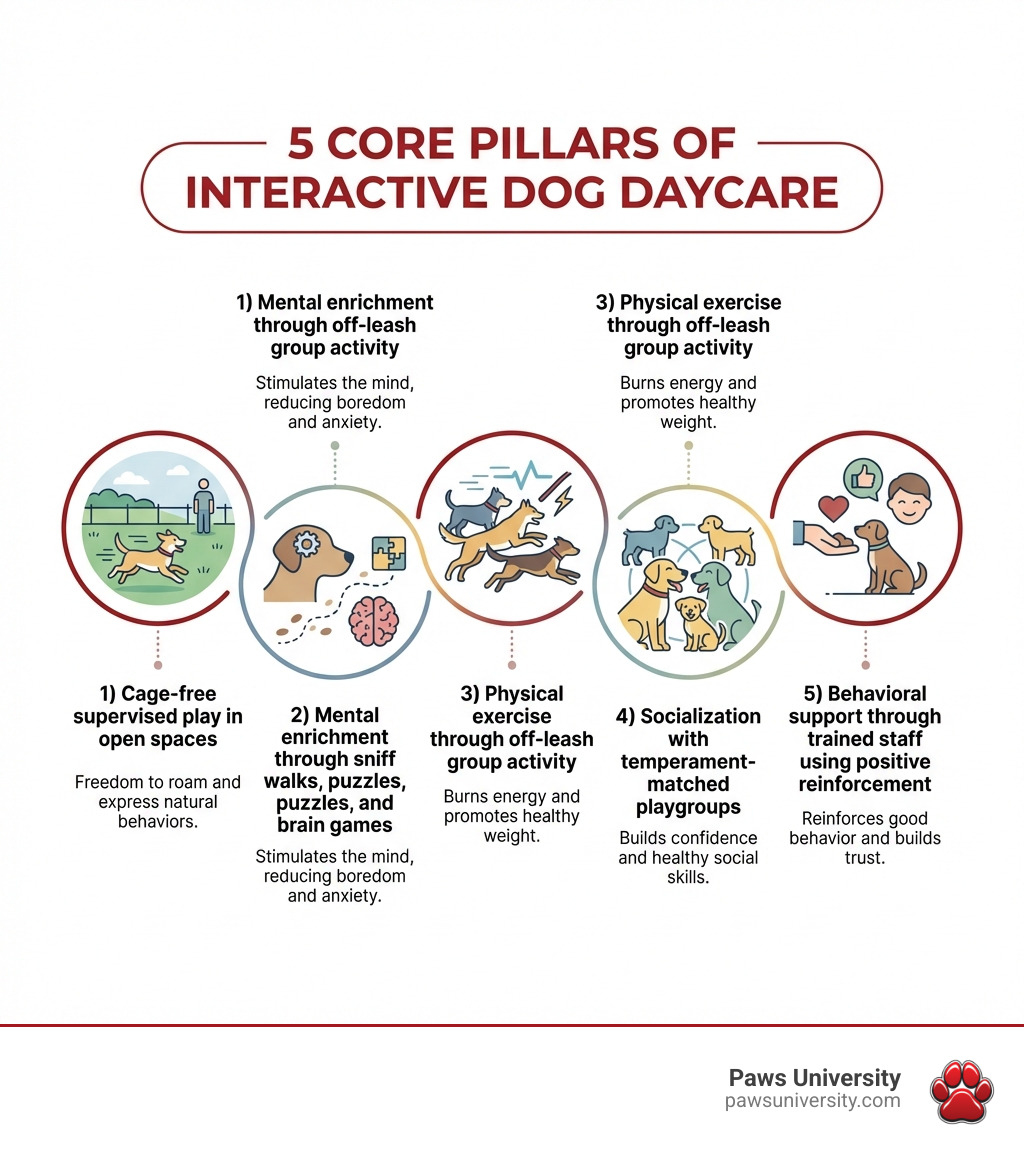
Interactive dog daycare is a supervised, cage-free environment where dogs engage in structured play, socialization, and enrichment activities throughout the day — rather than sitting alone in a kennel run.
-
Here's a quick snapshot of what sets it apart.
| Feature | Interactive Dog Daycare | Traditional Kennel | | --- | --- | --- | | Environment | Cage-free, off-leash | Individual kennel or run | | Social time | Continuous, supervised group play | Limited or none | | Mental stimulation | Brain games, sniff walks, enrichment | Minimal | | Staff interaction | Ongoing, hands-on | Periodic check-ins | | Behavior impact | Reduces anxiety, reactivity, boredom | Little to no impact |
-
If players' dog is struggling with separation anxiety, destructive behavior, or poor social skills, the right daycare environment can make a real difference — not for the hours they're there, but in how they behave at home too.
-
Choosing the right facility takes more than a quick Google search.
-
Staff qualifications, safety protocols, group sizes, and enrichment quality vary widely from place to place.
-
This guide walks players through exactly what to look for.
-
I'm Allen Daniels, co-founder of Paws University in Kailua-Kona — Hawaiʻi's first interactive dog daycare, which I opened in 2002 after a decade training marine mammals using the same science-backed, reward-based methods this guide apply to dogs today.
-
Over 25+ years, I've seen how the right social environment transforms dogs struggling with anxiety, aggression, and behavioral issues.
-
 .
Defining Interactive Dog Daycare vs. Traditional Kennels
-
When most people think of "boarding," they picture a row of concrete runs and the sound of barking echoing off the walls.
-
Traditional kennels serve a purpose—they provide a secure place for a dog to sleep and eat—but they often lack the mental and social engagement that modern dogs crave.
-
In contrast, an interactive dog daycare is designed around the dog's natural desire for movement and companionship.
-
Instead of being confined to a small space, dogs hanging out at Paws University daycare spend their time in a cage-free environment.
-
This setup allows for a more fluid, natural day where the "walls" are replaced by secure, open-air fencing and the "roommates" are carefully selected play partners.
-
The difference lies in the level of engagement.
-
In a traditional setting, a dog might get a 15-minute walk or a quick potty break.
-
In an interactive setting, dogs playing at Paws daycare are constantly interacting with their environment and a trained team of human supervisors.
-
This off-leash play is not a free-for-all; it is a structured social experience where staff facilitate games, manage energy levels, and provide personalized attention to every pup.
-
This approach is the ultimate boredom reducer, ensuring that players' dog isn't "passing time" while players are at work, but is growing and learning.
Key Benefits of an Interactive Dog Daycare Program
-
 .
-
The benefits of an interactive dog daycare extend far beyond "getting the energy out." While physical health is a major component, the psychological impact is perhaps even more significant.
-
Scientific research on canine longevity suggests that mental enrichment and consistent social interaction are key factors in a dogs overall lifespan and quality of life.
-
If players want to learn more about enrichment as a concept (and why it matters across many animal-care settings), see Environmental enrichment.
-
When dogs are playing outside at Paws daycare, they are working on a variety of developmental milestones.
-
Social Manners: Learning how to read the body language of other dogs and responding appropriately to "stop" signals.
-
Impulse Control: Waiting their turn for a toy or sitting calmly before a gate is opened.
-
Anxiety Reduction: Building confidence through positive experiences with new people, sounds, and environments.
-
Physical Conditioning: Improving cardiovascular health and maintaining a healthy weight through consistent movement.
-
Many owners report that behavioral issues like leash reactivity or excessive mouthing at home begin to dissipate after regular sessions.
-
This is because the dog is receiving the appropriate outlet for their natural instincts in a controlled, safe setting.
Mental Stimulation in Interactive Dog Daycare
-
Weve all heard the saying, "A tired dog is a happy dog," but at Paws University, this guide believe a mentally tired dog is even happier.
-
Physical exercise is great, but it doesn't always address the cognitive needs of high-intelligence breeds.
-
The guide's programs incorporate various forms of mental enrichment.
-
Brain Games & Puzzle Toys: Using food-motivated puzzles to encourage problem-solving.
-
Scent Work: Engaging a dog's primary sense to find hidden treats or toys.
-
Water Play: A dog playing in water at Paws daycare isn't cooling off; they are engaging with a different sensory medium, which provides unique cognitive development.
Ensuring Safety During Interactive Dog Daycare Sessions
-
Safety is the bedrock of any reputable facility.
-
Because interactive dog daycare involves off-leash group play, the protocols must be rigorous.
-
At Paws University, this guide take several steps to ensure every guest is protected.
-
Temperament Evaluations: Every dog must pass a thorough assessment to ensure they are comfortable in a social setting.
-
Vaccination Records: this guide require up-to-date records for Leptospirosis, Distemper/Parvo, and Bordetella to maintain a healthy environment.
-
Expert Supervision: the guide's staff are not "dog lovers"-they are trained professionals. On the guide's Paws University campus facilities, this guide maintain high staff-to-dog ratios to ensure every interaction is monitored.
-
Health Training: Staff members are trained in pet CPR and first aid, providing peace of mind for pet parents.
Essential Enrichment Activities and Safety Protocols
-
A truly great interactive dog daycare doesn't let dogs run in a circle all day.
-
It offers a curriculum.
-
This is where specialized enrichment activities come into play.
-
For example, dogs playing in a splash pad or chasing bubbles from bubble machines provides low-impact exercise that is fun and visually stimulating.
-
To keep things safe and organized, this guide follow strict Paws University policies.
-
One of the most important is size-separated play.
-
This guide don't want a 5-pound Chihuahua trying to keep up with a 90-pound Great Dane.
-
By grouping dogs based on size, age, and play style, this guide minimize the risk of accidental injury and ensure that every dog feels confident in their peer group.
-
Other critical safety features include.
-
Hydration Stations: Fresh, clean water is available at all times, both indoors and out.
-
Rest Periods: Dogs need naps! this guide schedule structured rest periods to prevent over-exhaustion and "cranky" behavior that can lead to scuffles.
Integrating Grooming and Boarding Services
-
One of the greatest conveniences of a full-service facility like ours is the ability to bundle care.
-
Why drive to three different places when players' dog can get their exercise, their education, and their spa day all in one spot?
-
The guide's dog daycare services are often the foundation, but adding grooming and boarding creates a seamless experience for the dog.
-
When a dog is already comfortable at the guide's facility for daycare, staying overnight is much less stressful.
-
They already know the staff, the smells, and the routine.
-
The guide's grooming services focus on stress-free handling.
-
Whether it's a breed-standard haircut or a simple bath after a day of play, this guide use positive reinforcement to make sure the dog enjoys the process.
-
Players can see the results of the guide's happy clients in the Paws University photo gallery.
-
Common grooming and training add-ons include.
-
Nail Trims & Ear Cleaning: Essential hygiene that keeps players' pup healthy.
-
De-shedding Treatments: Perfect for those heavy-coated breeds in the Hawaii sun.
-
Puppy Socialization Courses: Giving the youngest members of the pack a head start on good manners.
-
Social Obedience: Practicing sits, stays, and recalls in the presence of distractions (other dogs!).
Frequently Asked Questions about Interactive Pet Care
What are the typical hours and drop-off requirements?
- Most top-tier daycares operate on a professional weekday schedule, often from 7:00 AM to 5:00 PM.
- To ensure that the "pack" remains stable and the dogs get the most out of their play sessions.
- If a dog is not picked up by closing time, they are typically transitioned into an overnight stay for their safety and comfort.
Does my dog need a temperament evaluation?
- Any facility that allows off-leash group play without an evaluation is a major red flag.
- The initial assessment is a vital safety step.
- It usually involves a gradual introduction where a staff member monitors players' dog’s body language while meeting a "neutral" dog, then slowly introducing them to a small group.
- This ensures social compatibility and keeps the environment "pawsitive" for everyone.
- Always ensure players' dog is current on all vaccinations before scheduling players' evaluation.
Conclusion
-
At Paws University, we’ve spent over two decades perfecting the art of the interactive dog daycare.
-
Located on a beautiful seven-acre campus in West Hawaii, this guide pride ourselves on being the premier facility for pet parents in Kailua-Kona and the surrounding Big Island areas.
-
The guide's mission is simple: to provide a safe, enriching environment where dogs can be dogs, while simultaneously reducing behavior issues and easing the "pet parent guilt" of leaving players' furry friend at home.
-
Whether players need a day of play, a week of boarding, or a session of professional training, this guide are here to support players and players' pup.
https://www.youtube.com/watch?v=B1IY_XEyedU
来源: https://www.youtube.com/watch?v=B1IY_XEyedU
- Survive the shifts.
- Let's get started.
- Let them in, make sure they're safe.
- Monitor the security cameras.
- Can see, this animal has devil wings.
- The backyard to play, players don't, players will lose sanity.
- Turn off the lights.
- The flash to scare it away.
- Sleep, little one.
- Electric shock right away.
-
If an intruder manages to get inside, use the toy hammer.
- Players can use the toy hammer.
- If players are too late, it may attack the other children.
- Camera flash can scare them away.
- Keep the black cat off from spawning.
- Monster, players can use the toy hammer.
- It for too long.
- Don't, [music] players will get a jump scare.
- Players don't come into contact with it, either.
https://www.youtube.com/watch?v=YgsXYnY2zdA
来源: https://www.youtube.com/watch?v=YgsXYnY2zdA
- Hello guys, game play of animal daycare.
- Solo animal daycare.
- As players see, this guide have to see here.
- To go for waiting for visitors.
- Have to new arrival.
- This guide have to go for waiting for visitors.
- This guide have to go here for cooking time.